
“It shouldn’t be this difficult”: Melissa’s summer holiday struggle

Melissa and Andrew are parents to six-year-old twins Frankie and Otis, and two-year-old Remy. Frankie loves music and the theatre, while Otis is football mad and loves reading. As the twins have got older, planning family days out has become more difficult, especially in the holidays.
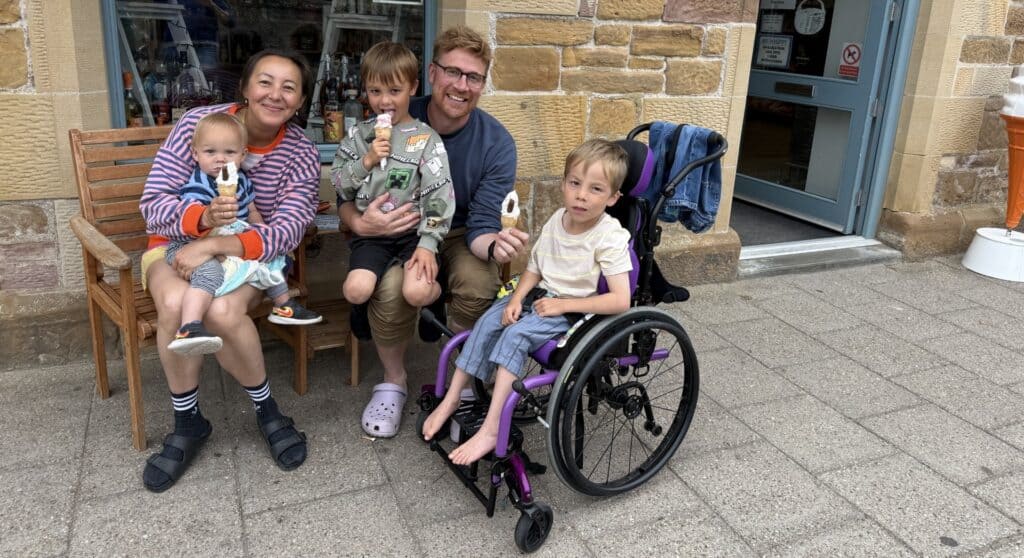
Frankie has cerebral palsy and uses a wheelchair full-time. During term-time, he attends a mainstream school with one-to-one support through his Education, Health and Care Plan (EHCP). But when the school holidays begin, that support disappears.
Melissa describes the challenges of navigating a system that varies widely between local authorities, with parents often left to research and fight for support themselves.
Our recent research reveals the scale of the challenge:
- 61,415 disabled children live in areas with no holiday club provision at all.
- Only 6% of disabled children receive holiday support, highlighting a huge national gap in provision.
- 57% of parent carers struggle to find accessible holiday clubs, while 27% say activities are unwilling to include their disabled child.
Melissa shares her story…
My family
My son Frankie is six and has cerebral palsy. Frankie has a twin brother, Otis, and a younger brother, Remy, who is two. The boys all get on really well, but they have very different interests.
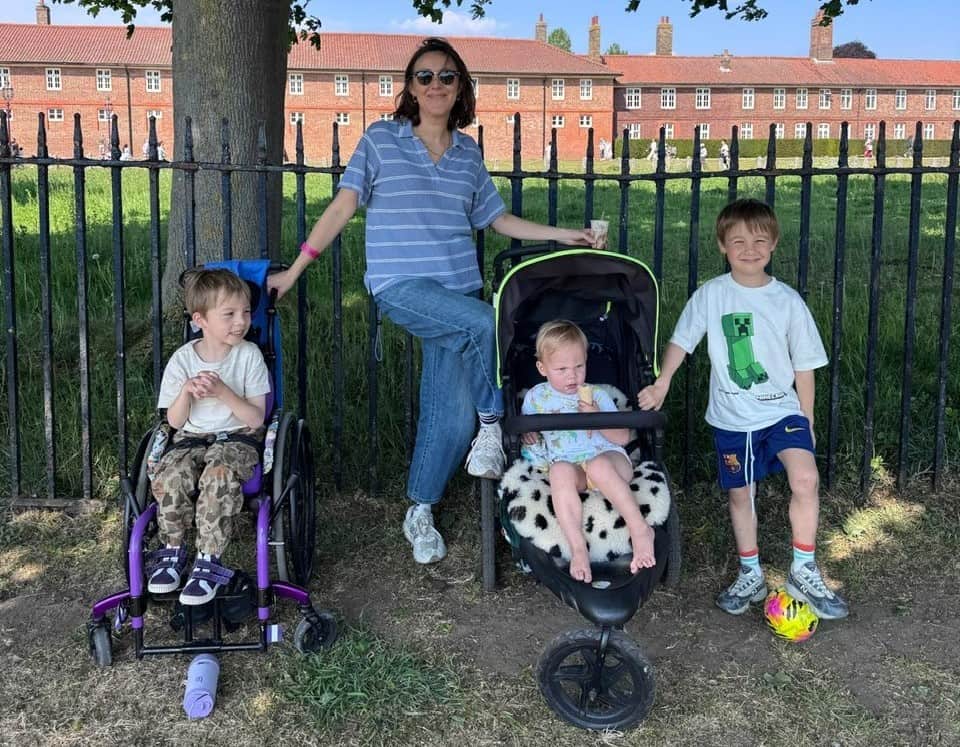
Frankie loves music, playing instruments and anything noisy. He loves going to the theatre and watching performers. Otis is football-obsessed, collects football cards and loves reading. As they’ve got older, it’s become more obvious that they want to do different things.
Frankie is a full-time wheelchair user and attends a mainstream school, where he has one-to-one support through his EHCP. He needs an adult all the time to help him access everything – taking him to the loo, helping him get his lunch, helping him look through a book, positioning him so he can see the board, getting him in and out of his wheelchair and walking frame.
Essentially, for anything outside of school, he needs the same support he gets at school.
That’s where school holidays become difficult.
The reality of our summer holidays
Each summer feels harder than the last.
Frankie’s getting older and doesn’t necessarily want to do the same things anymore. At the same time, Otis is becoming more interested in sports camps and activities that are much harder for Frankie to access.
I asked one sports camp whether they could accommodate Frankie, and they said yes, but only if he had an adult with him. The support that Frankie needs costs around £18 an hour, and that’s on top of the cost of the club. It just makes it unaffordable.
That’s the challenge we keep coming up against.
Frankie should be able to go to a holiday club with his friends in the same way he goes to a mainstream school.
But in reality, there’s always the question of who is going to provide and pay for the support he needs.
Our council funds 10 days a year for an adult to support Frankie at his school’s holiday club. That works because the adults already know him and understand how to include him.
But ten days is only ten days, and we had to fight for that support, too – it wasn’t offered to us.
They also sent us a link to what they call HAF clubs (Holiday Activities and Food clubs), but the ones Frankie can go to either have hardly any days or hours, or they are too far away.
How we manage
The plan for this summer is a patchwork of different solutions.
- We try to find something unsuitable for Frankie and think of ways we can make it suitable, which always comes with huge added costs.
- We call upon favours with family or friends.
- We take paid, as well as unpaid, leave from work.
- We use the school holiday club for two weeks with funded support, and the school very kindly waived the club fee to try and help us out.

As a family, we’re fortunate enough to be able to make some of this work.
If we didn’t have a disabled child, I probably would have gone back to work full-time. But when childcare, after-school clubs and holiday provision all require additional support, everything becomes a compromise.
We’re lucky that my mum lives close to the school and helps out. I know many families don’t have that support. I can see how people end up giving up work because it’s just not financially viable once you factor in the extra costs.
The frustration
What makes it more frustrating is how different support can be depending on where you live.
I know families in neighbouring boroughs who receive funded personal assistant hours every week for children with similar needs to Frankie.
We’ve been told that support simply isn’t available where we live.
There’s no consistency and often no clear explanation about how decisions are made.
We don’t even have a social worker. So many things – adaptations to the house, a Blue Badge, Disability Living Allowance, short breaks support – have been things we’ve had to research and figure out ourselves.
We’re planning to move to Surrey soon (to a house that we can adapt and make suitable for a wheelchair user), which is notoriously bad for special educational needs and disabilities (SEND). But you can’t just rule out a whole borough, can you? I’m just moving there, prepared to have to fight for everything, basically.
I’m not naturally a fighter, but I am somebody who researches things and I’ve had to learn how to fight and advocate for my son. I like a project. Even so, it’s exhausting. You shouldn’t have to spend hours trying to work out what support exists and whether you’re entitled to it.
It exhausts me mentally because the logistics are so complicated.
There are endless options for Otis – whatever his interests may be, there will be things he can go and do. But for Frankie, it’s so much more limited.
My plea to decision-makers
For me, the biggest thing that needs to change is that support should be based on need and it should be more consistent.
It shouldn’t depend on what borough you happen to live in.

There should be somebody saying, “You can apply for this, this and this. These are the people who can help you.” Instead, a lot of parents end up relying on information shared by other families.
Frankie attends a mainstream school and gets one-to-one support there. To me, it feels simple that the same principle should apply during school holidays.
Children who can access mainstream activities with the right support should be able to do so without families facing huge additional costs.
At the moment, Frankie doesn’t realise all the work that goes on behind the scenes to make things happen. We do our best to make sure he’s included and that he can take part in the things he enjoys. He doesn’t know how much organising, researching and paying for support involves, and I wouldn’t want him to.
But it shouldn’t be this difficult. Families already have enough to juggle without having to fight for support at every stage.